History of our Church
This page offers an overview of our church’s journey—how we began, the milestones that shaped us, and the people and faith that brought us to where we are today. We invite you to explore our story and discover the foundations of the community we continue to build.
The ground on which the building of St Oswald stands has been consecrated as a place of worship since before 1180. When Uctred was appointed to serve here in 1200 he became the first in a long line of priests that has continued to this day.
Aysgarth Church was Mother Church of the district and Askrigg was a chapel-of-ease covering the whole area from a little west of the Aysgarth to the dale head. Eventually, from about the 15th century, as the population expanded, further parishes were created at Hawes, Hardraw, Lunds and Stalling Busk. When the dale’s population began to decline from the 19th century, the reverse happened as parishes were conjoined: Hardraw and Lunds (1858); Askrigg and Stalling Busk (1930); Hawes and Hardraw (1953).
The small parish church of St Matthew’s at Stalling Busk is situated on the hill overlooking Semerwater. It was built in 1909 and at that time was very innovative as it is a beautiful example of Art Nouveau architecture with lovely stained glass windows. It is well worth a visit.
Prior to the building of St Oswald’s Church, there was a religious presence in the area. Local tradition suggests that an area at the east of the village, known as Kirk Close, had a preaching cross called St Oswald’s and perhaps a Saxon church. If there was no church building the spiritual needs of local folk were met by travelling monks who preached beside the cross and baptised people. Evidence shows that in 1145 Cistercian monks established Fors Abbey, a wooden building at Dale Grange, a mile west of Askrigg. However, the climate was too harsh so the abbey was abandoned and the monks moved to Jervaulx c15 miles east of Askrigg. The Cistercians continued to own extensive estates in the dale and took tithes (a tenth of all produce) from their Askrigg lands.
The monasteries were dissolved in 1539 and later Queen Mary gave the tithes to Trinity College, Cambridge. From that time, therefore, the labour of the dale’s hill farmer contributed to the glorious buildings and the scholarship of Trinity College. Trinity appointed the priest at Aysgarth (and still does) and Aysgarth in turn found and appointed a priest at Askrigg.
The present building of St Oswald dates from about 1446 with the nave and south aisle being in the Late Early-English and Perpendicular styles. The main glory is the nave ceiling with its beautiful beams, said by Pevsner to be the finest in the North Riding. The north aisle was added slightly later and because the arches do not fit the piers which are in the round Norman style, an unlikely tradition has been perpetuated that the round piers came from a monk’s chapel at Fors Abbey. The south aisle was rebuilt in a restoration about 1770. The whole church underwent a disastrous and extensive restoration in 1853. Changes included replacing the simple windows with a mock gothic style and adding many furnishings. Fortunately, the basic shape was not touched, neither were the fine proportions spoilt.
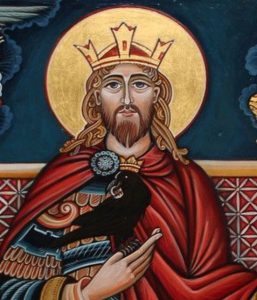 Our church is dedicated to St Oswald and visitors often ask just who Oswald was and about his connection to this area.
OSWALD was born around 604 to Ǣthelfrith Iding, the king of Bernicia and Deira and his wife, Acha Yffling, the daughter of Ǣlle, who was King of Deira at the time of her birth. Oswald was their oldest child, born a year or so after their marriage. Ǣthelfrith was one of the greatest early medieval warlords and he died in battle when Oswald was in his early teens. Acha had at least six sons and a daughter.
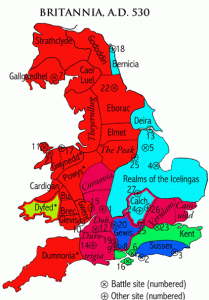
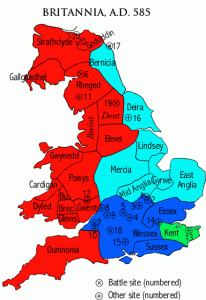
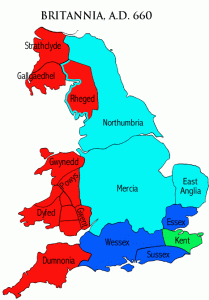
Britannia before and after Oswald’s reign
Oswald Iding ruled Northumbria for 8 years from 634-642. During this period, he was recognised as the ruler of most of the kingdoms of Britain – including Mercia, East Anglia and Wessex. He was undoubtedly a fine warrior in the mould of his father, and he was the first English king to die a Christian martyr. He is often described as an exiled prince whose destiny was to return home to reclaim his birth right. Oswald’s historical significance is greater than nearly all before or since. He forged cultural links with all parts of Britain, which gave rise to an age of arts and language, the foundation of the monastery on Lindisfarne and his political legacy could be said to include the crusades. Interestingly, JRR Tolkien based Aragorn, in his fantasy novel, Lord of the Rings, on Oswald.
Oswald was born probably at Gefrin (Yeavering), the ancestral summer hillfort palace of the ruling Iding family in today’s Northumberland. We don’t know much about his early years, but what we do know begins around 616AD.
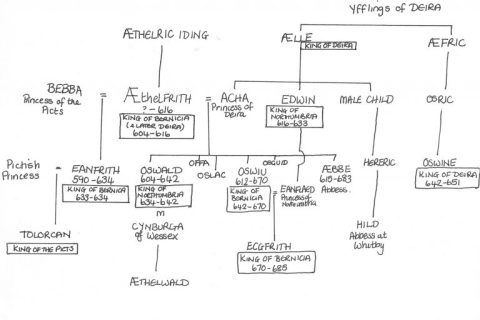
Ǣthelfrith was killed in battle by Rǣdwald of East Anglia around 616 and in those days there was no automatic right for a son to inherit a kingdom, especially if they were a child. Edwin, Oswald’s uncle, was crowned king and his sister, Ache, mother of Oswald, gathered up her children and fled to her husband’s Scottish allies, the Dal Riata tribe. A small boat transported 12 year old Oswald, his younger brother Oswiu, who would one day succeed him, and his baby sister Æbbe (a future abbess of Coldstream). Oswald’s other brothers are likely to have been with them and possibly Acha herself, but no records exists of them. The family went to Iona, were taken in by the monks and received an education befitting their royal status. Oswald remained on Iona until he was 30; transforming from a heathen English child refugee into a crusading Christian prince.
Following Edwin’s own death in 632 in battle against Cadwallon of Gwynedd and Penda of Mercia at the battle of Hatfield Chase in Nottinghamshire, Oswald began his journey home to claim his kingdom. It was almost a year before Oswald was in a position to challenge Cadwallon and during that time Cadwallon and his troops had laid waste to Northumbria. Oswald brought with him an army of Scottish and Ionian warriors, a contingent of Pictish warriors sent by his half brother’s family and had also gathered supporters on the march south. The night before the battle, Oswald’s army were camped on the banks of the river Denisburn and the odds were overwhelmingly against them. As night fell, Oswald looked up at the stars and took comfort from the sight. As he did so, a dream-like figure came down to him and told him that God had promised him victory. Oswald thought that the figure had been St Columba.
Ǣthelfrith was killed in battle by Rǣdwald of East Anglia around 616 and in those days there was no automatic right for a son to inherit a kingdom, especially if they were a child. Edwin, Oswald’s uncle, was crowned king and his sister, Ache, mother of Oswald, gathered up her children and fled to her husband’s Scottish allies, the Dal Riata tribe. A small boat transported 12 year old Oswald, his younger brother Oswiu, who would one day succeed him, and his baby sister Æbbe (a future abbess of Coldstream). Oswald’s other brothers are likely to have been with them and possibly Acha herself, but no records exists of them. The family went to Iona, were taken in by the monks and received an education befitting their royal status. Oswald remained on Iona until he was 30; transforming from a heathen English child refugee into a crusading Christian prince.
Following Edwin’s own death in 632 in battle against Cadwallon of Gwynedd and Penda of Mercia at the battle of Hatfield Chase in Nottinghamshire, Oswald began his journey home to claim his kingdom. It was almost a year before Oswald was in a position to challenge Cadwallon and during that time Cadwallon and his troops had laid waste to Northumbria. Oswald brought with him an army of Scottish and Ionian warriors, a contingent of Pictish warriors sent by his half brother’s family and had also gathered supporters on the march south. The night before the battle, Oswald’s army were camped on the banks of the river Denisburn and the odds were overwhelmingly against them. As night fell, Oswald looked up at the stars and took comfort from the sight. As he did so, a dream-like figure came down to him and told him that God had promised him victory. Oswald thought that the figure had been St Columba.
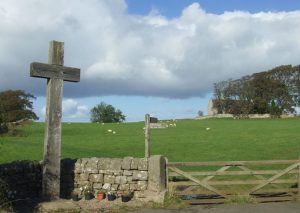 Oswald woke his men and together they fashioned a cross from two long pieces of wood and when it was finished, they dug a hole and placed the cross upright, stamping around it until the cross was secure. The dawn broke and a shaft of sunlight fell on the cross. Oswald dropped to his knees and encouraged his army to kneel and pray that ‘the true and living God would defend us from this cruel and fierce enemy’.
Once they had finished praying the army rushed to meet their enemy. The battle was long, but Cadwallon was slain and Oswald had won. The place was renamed Heavenfield.
Oswald was now king of Northumbria, but the land was in misery, poverty and hunger having had no government or law enforcement for a year and no churches or clergy, remaining a pagan kingdom. Oswald looked to his former home and sent to Iona, asking the Abbot to send him a Bishop to help with the reconstruction of his Northumbria. They sent Aidan, a young Irishman, whom Oswald will have known from his time in Iona. Oswald gave Lindisfarne for his base.
From that time onwards these two worked together for Christ and the people; often working at Oswald’s power base at Bebbanburg, which stood on what is now known Bamburgh Head. Babbanburg had long been associated with the Bernicians. Æthelfrith had given the settlement to his first wife Bebba, a pictish princess, and it had been renamed Bebbanburg – the settlement of Queen Bebba.
Oswald built churches and gave his wealth and lands to found monasteries. Aidan baptised, preached and ordained priests. Aidan was Irish by birth and did not know the English language. When he preached at the king’s court, Oswald himself translated.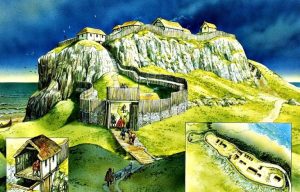
Oswald’s good works were not confined to his own lands. He developed many alliances and good relations with other kingdoms, acting as godfather when the pagan king of Wessex was baptised into the church. Deira and Bernica, the two parts of Northumberland were made into one kingdom. Oswald was showing a new kind of kingship – a brave warrior, but also a wise ruler and a kind father to his people. He was always courteous and affable with the poor and sick. Despite being king, Oswald was never seduced by the power and continued to live a life of prayer and self-denial.
One Easter day, when Oswald was having dinner with Aidan, a silver platter of delicacies was put in front of them. Oswald had just asked Aidan to say grace, when a servant came in and told Oswald that there were a great number of poor people outside asking for alms. Oswald looked down at the platter full of meat and told the servant to take it out to them and then to cut the platter into pieces and distribute it amongst them. Aidan, watching this, was full of joy at Oswald’s kind heart. He took hold of Oswald’s right hand and said, ‘May this hand never grow old’.
Oswald married Cyniburh, the daughter of an ally, King Cynegisl of Wessex in 635. Their reign saw increasing prosperity and growth in Northumbria. However, 8 years into his reign, Penda, the heathen king of Mercia fought and killed the Christian king of East Anglia; and Oswald gathered his army and marched to rescue the conquered people from Penda.
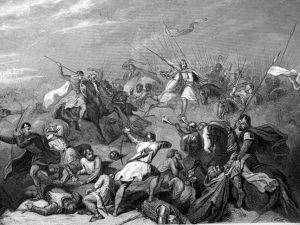 Oswald drove Penda back to the Welsh border, and a great battle was fought on 5 August 642, known as the Battle of Maserfelth. This battle did not go well and his faithful warriors fell one by one at his side. Oswald knew that the battle was lost and prayed to God for the souls of all the soldiers who had died that day, of whatever side.
He was cut down by the marauding army and a great shout went up when they knew they had killed the king. Penda had no respect for Oswald and cut off each of his limbs and put them on spikes. This place became known as ‘Oswald’s Tree’, nowadays we know it better as Oswestry. The place where Oswald’s body had fallen became holy ground and people kept taking handfuls of soil away, until there was a deep crater!
Oswald’s kingdom was split after his death; although he had a son, he was still a young child and so he was succeeded by his brother Oswiu, who ruled Bernicia and by Oswine (a distant cousin) in Deira . Once Oswiu had secured Deira, he set out for Oswestry and brought Oswald’s remains back to Bamburgh. They were interred in a silver casket.
Miracles began to be associated with both the site of Oswald’s death and the site of his interred remains. It was said that Aidan’s words had become true and his right hand remained as it had in life and it became a site of pilgrimage from as early as 643.
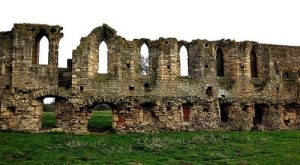 Oswald’s remains were moved to Bardney Abbey in Lindsey by Oswald’s niece Osthryth. When Bardney became Viking territory in the early 10th century, Ǣthelflǣd, daughter of Alfred the Great, carried out a raid on the Abbey and removed Oswald’s remains to Gloucester, in a new minster named St Oswald’s priory to honour his memory where Ǣthelflǣd and her husband would later be buried.
Oswald’s head is said to be in Durham cathedral, alongside that of Cuthbert; but there is no proof of this, and as with other saints, many churches claim to have parts of Oswald’s body, including some overseas. Peterborough Cathedral has a chapel dedicated to Oswald, which was said to house his arm during the Middle Ages.
Oswald was made a saint in the early medieval period, but the exact date is not known. His exploits are recorded in many historic documents, including those by the Venerable Bede.
As well as many churches in the North bearing Oswald’s name, including our own, there are other places such as Oswaldtwistle in Lancashire, and Kirkoswald in Cumbria, which are believed to have been named after places were Oswald’s body was taken after his death on his journey back to Bebbanburg.
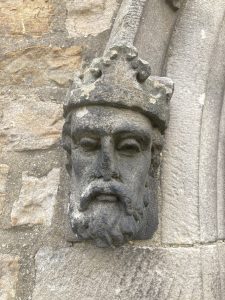 A church was built at Heavenfield shortly after the battle and Anglo-Saxon church was replaced with a Norman building, which stands today, close to a replica of the cross erected by Oswald on the eve of the battle. We do not know when our church was dedicated to St Oswald. It is possible that the Saxon church which predated our current church was dedicated already dedicated to St Oswald. Stone images of Oswald and his queen, Cyniburh, appear on the outside of the church on either side of the south door.
Further Reading:
Max Adams: The King of the North, the life & times of Oswald of Northumbria 2013
Bede: Historia Ecclesiastica gentis anglorum 731