History of our Church
This page offers an overview of our church’s journey—how we began, the milestones that shaped us, and the people and faith that brought us to where we are today. We invite you to explore our story and discover the foundations of the community we continue to build.
The evolution of the Parish of Hawes
Early development of churches in the upper dale started with buildings in Aysgarth and Askrigg in the 12th century. Jervaulx Abbey was the patron of the parish and no doubt supplied some of the clergy. For centuries people in Hawes would be travelling to Aysgarth or Askrigg for services, baptisms, marriages and funerals. At this time the churches were under the authority of the Roman Catholic Church. The first priest appointed in Hawes occured in 1483 when Sir James Whaley ‘ in the first year of King Richard III ….(he) was appointed to sing at the chapelle of Haws in Wensleydale for one year, for a salary of seven marks’ (£4. 11s 4d). Hawes was part of the Manor of Bainbridge – which in turn was part of the estate of Middleham Castle, one of the residences of King Richard III. There was not necessarily a church building in Hawes at this time and it was not until the end of the 16th and beginning 17th centuries that chapels of ease were built in Hawes, Hardraw, Stalling Busk and Lunds. (all still in the parish of Aysgarth and with pastoral links to Askrigg). By now The Church of England was established with Henry VIII’s separation from Rome in the mid 16th C and the dissolution of the monasteries.
The 16th and 17th centuries saw a marked increase in the population of the upper dale and Hawes began to agitate for parish independence. Robert Dobson who died in 1676 and buried at Askrigg is referred to as ‘the minister for Hawes’. From that time the names and dates of Clergy are known. The fight for ‘independence’ from Askrigg continued in 1680 with a refusal to pay the ‘Hawes Quarter’ and dispute resolution was sought in the ecclesiastical courts in Richmond and York, followed by the common law court in York. Despite this the church building in Hawes was still called ‘the chapel’, the minister called ‘curate’ and the administration of sacraments were still taking place at Aysgarth or Askrigg. The earliest records that survive containing baptisms, weddings and funerals in Hawes date from 1695.
The old Chapel
The old chapel building, probably existing from 1620, is best described as a ‘barn-church’ and was rectangular, quite low, and without aisles or tower (a good surviving example of this type may be seen at Chapel-le-Dale on the road to Ingleton.)
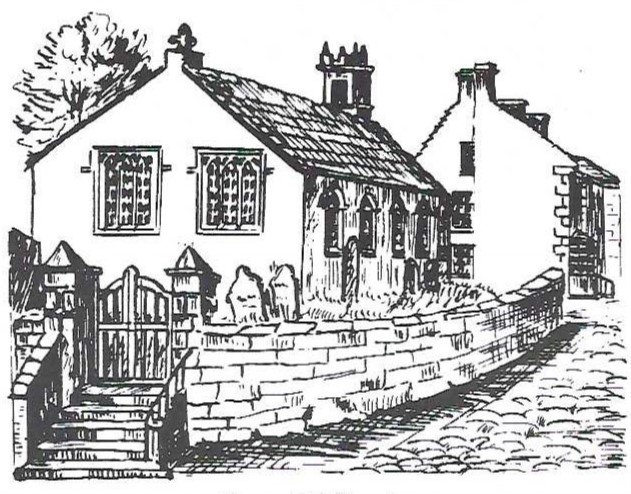
It was extended in 1712 by 10 foot and again had major alterations in the mid 1760’s including new seats and windows. The seating cost £100. The building was next to the roadside and opposite the White Hart and by now had two east windows, five windows on each side and a bell tower. There were two entrance gates – one by the shop and one by the White hart. The floor was stone flagged and there was a gallery at the west end.
However, as the Hawes congregation grew beyond its capacity to hold them, a new building became essential. The Diocese conceded the need in 1849 and planning followed and fund-raising began. Most of the money needed was raised quite swiftly – with a long and impressive list of over 200 donors. The foundation stone was laid on July 25th 1850.
Thereafter Hawes – in effect if not yet quite in law – ceased to be technically an adjunct of the vast and unwieldy ancient parish of Aysgarth, at that time the second largest in England, covering 81,000 acres. When, in 1870, the term Perpetual Curate ceased to be employed – over the years it had come to imply an inferior status – Hawes had, at long last, its own Vicar and freehold Vicarage.
The building of St Margaret's
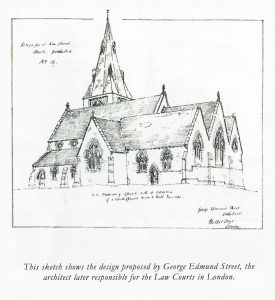
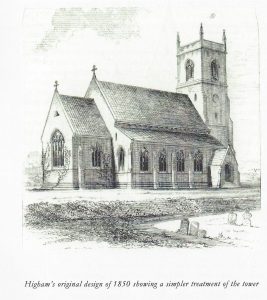
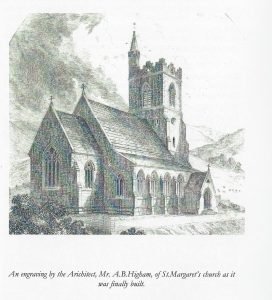
The work began on the present building in 1850 following plans drawn up by a Wakefield architect, A. B. Higham. He worked broadly in the so-called Decorated mode, which many apostles of the Gothic Revival – then at its height – considered the finest of all English church styles. Of far more interest is an alternative design – the church that never was – by a Victorian architect, George Edmund Street, who had only set up his own practice in 1849. Both original and prolific, he was soon to become very famous, influencing many major figures like William Morris and Philip Webb. His best-known work is the Law Courts in London and his vigorous church design with its transepts, triple aisles, large chancel and broach spire would, had it been built, probably have been his first major commission and, as such, would nowadays bring amateurs of Victorian architecture from far and wide. Perhaps it was too avant–garde for whoever made the choice or – more likely – it would simply have cost too much. Even Higham’s design, for such a rural church, is a large building, perhaps too large, and one cannot help feeling that maybe those who set it up on such a scale still had a bone to pick with Aysgarth. The church has Higham’s original design, dated 1850, then without its characteristic little spirelet topped by a weathervane on the tower. It seems it was initially meant to be sited where the old church stood. But in the event it was – we don’t know at whose instigation – set on its present hill-top site, from which it effortlessly dominates the town, and is visible in all directions for many miles. Nevertheless, it only cost £2,450, according to the contemporary accounts and specifications and only took about a year to build. Most of the workmen were local – a few others were brought in by the architect, who by the way got just £88.00 in fees. At the time Mr. Edward Moore made some interesting notes about the builders and their work-, of which a selection follows:
“The resident Architect was named Dixon, [he was in reality the Clerk of Works, paid £ 133 as ‘salary‘] and he lodged with Betty Scarr all the time it was building.
The builders’ names were Edmund Dick, Dick Fothergill, John Jeff and Lang Anty [probably a nick-name for Long- i.e .. tall -Anthony]; they had two labourers or hod carriers, Jimmy Kelly and Little Peter, both Irishmen. Jimmy stayed with the Hawes masons many years after the church was finished. The stone cutters or hewers were strangers. John Warren did all the woodwork, Bowes did all the glazing and Mike Dinsdale all the ironwork, Ralph Stockdale carted all the stone from the top of Snaize(holme] Fell; it was brought from the top down to the road in Lang Gill on a sort of sledge: [It can be inferred – as their names also suggest – that the last-named four men were local too. And certainly not all the stone came from snaizeholme, where there was none suitable for ashlared work]
When the last stone was fixed on top of the turret, Little Peter stood on it on one foot, waving the other and his arms to muse the spectators below. The hewers were continually pestered with women who went to pick up any tidy sized chippings of freestone to stone their floors with.” [To stone here means to scour].
Among other things, this entertaining account – how one would like to have met the daring Little Peter – shows us how relatively few changes in building practice had occurred since mediaeval times when stone was – wherever feasible – locally quarried, and horse-drawn “sleds’ used to drag it to the nearest road where wheeled wagons could take over, a back-breaking task for all involved, especially the unfortunate horses.
The old church which abutted on the main street at the foot of the hill was, of course, pulled down and its stones utilised by all and sundry, some doubtless for the new church. The Faculty for pulling it down insisted that all ‘usable slates’ should be set aside and re-used on the south [i.e .. less exposed] face of the new roof. Apart from this, few traces of it remain, except some rather undistinguished memorials to the wealthier local residents, which were transferred to the new building, and one or two other features which will be pointed out as they occur. The most ancient of the three grave-yards is that surrounding the church but we have hardly any really ancient tomb- stones, because the local stone used is subject to splitting and flaking in our – often harsh – winters, There remains just one ancient stone, to the right of the front path It dates from 1696 and – unsurprisingly- commemorates a Metcalfe. Both its stone and its rather crude lettering are evidently local, the work of Hawes quarrymen and masons.
Acknowledgements to
James Alderson (Under Wetherfell ). Drawing of ‘Old Church’ by Lily Alderson
and
Dr Trevor Johnson and Hugh Bridgman
Compiled by Mike Hirst
Click to enlarge
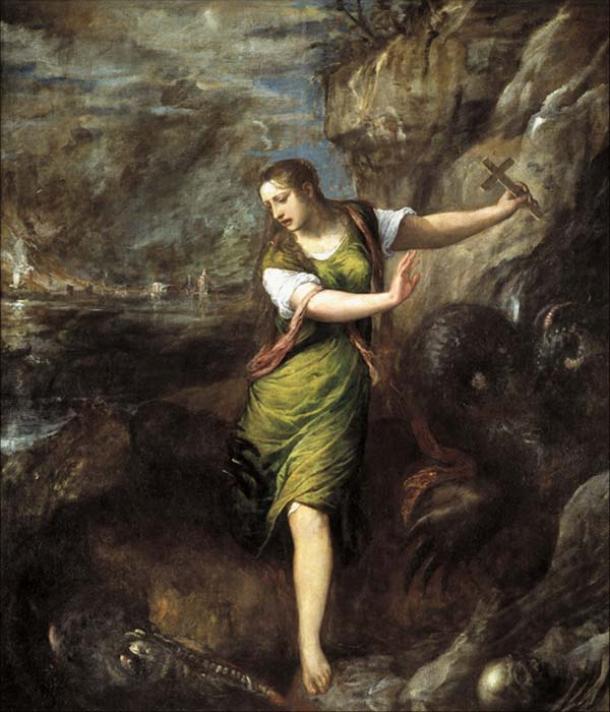
Saint Margaret’s Church in Hawes is considered to be dedicated to Saint Margaret of Antioch
Nothing certain is known of her, but according to an untrustworthy legend compiled in the 13th Century, she was the daughter of a pagan priest called Theodosius in Antioch of Pisdia (Turkey) in the 3rd and 4th Century. Her mother had died in childbirth. Also known a Marina, she was converted to Christianity whereupon she was driven out of her home by her father. She lived in the country 6-8 miles outside Antioch, with a nurse as a foster-mother and she became a shepherdess. When she was 15, Olybrius, a Prefect under the Roman Emperor Diocletian, was infatuated with her beauty and he asked her to marry him.
However, the condition was that she renounced Christianity. Upon her refusal, he had her tortured and then imprisoned. Marina frankly replied to the man: “Have no vain hope for me, O governor, that I might cower before any number of torments. Nothing will separate me from Christ – neither affliction, famine, fire, sword, nor any other harsh tribulation – not even a violent and very painful death. (see Romans 8 v 35ff)
While she was in prison she was believed to have had an encounter with the devil in the form of a dragon. According to the legend, he swallowed her, but the cross she carried in her hand so irritated his throat that he was forced to disgorge her. The next day, attempts were made to execute her by fire and then by drowning, but prayers kept her unharmed and she was miraculously saved. Thousands of spectators who witnessed her ordeal were converted to Christianity – all of whom were promptly executed. Finally, she was beheaded at the age of 16 in AD 304. Her remains are considered to have been initially at Panteponteia Monastery and maybe later transferred to Italy and then to Athens.
That she existed and was martyred may be true; all else is probably fictitious embroidery that adds to her legend. At various times the Roman Catholic Church denounced her, suggesting that she had never existed, however during the time of the crusades and into the Middle Ages, she became popular in Western Europe. She was one of the fourteen ‘Holy Helpers’ whom the Roman Catholics believe would pray for people in need. Joan of Arc believed that she heard the voice of Margaret of Antioch encouraging her in her mission to the French King. Her victory over the dragon led to her being regarded as a protector against demonic powers.
The cult of Saint Margaret became very widespread in England, where more than 250 churches are dedicated to her, including 48 in Norfolk, but her cult was suppressed by the Roman Catholic Church in 1969 as they doubted that she had ever existed. She is considered to be the patron saint of pregnant women and childbirth, of dying people, nurses and people in exile and of peasants.
In art she is sometimes represented as a Shepherdess or, as on our church banner, pictured standing on the dragon.
Her feast day is celebrated on 20th July in the West and in the East on July 13th.
Judgements about what we can believe of the story of Margaret need to be understood in the light of the truths that we believe from scripture. Jesus and only Jesus is the one who intercedes for us and in him only is salvation found.
Christ Jesus, who died – more than that who was raised to life, is at the right hand of God and is also interceding for us. Romans 8 v 34
Peter talking before the Jewish legal court and speaking of Jesus says: ‘Salvation is found in no-one else, for there is no other name under heaven given to men by which we must be saved’ Acts 4 v 12
Acknowledgements:
An earlier church pamphlet (authors unknown)
Encyclopaedia Britannica
Mike Hirst
Keeping records
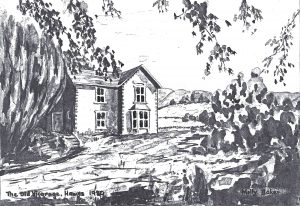
St Margaret’s Vicarage 1980
Regrettably, records from Hawes Chapel (the old church) and the first half-century of St. Margaret’s Church are far from complete. Though some from the late 17th C and most of the 18th C documents survive there is a hiatus for nearly the whole of the 19th C when, so it is said, they fell victims to the mice and damp where they were carelessly stored. A list of those that have survived and are now lodged in the County Records Offices at Northallerton. More recent 20th – 21th C Registers are still held in the church safe. From these and other documents it appears that while Aysgarth was always the ‘mother’ parish, there were also some pastoral links with Askrigg and it was from these that clergy, usually ‘Assistant Curates’ were appointed. From the 17th C onwards it is likely that such curates were resident in Hawes at least intermittently, though probably only in lodgings. The Old Parsonage (now replaced) was only built in 1863. The dispute about tithes and who should benefit from them had finally come to a head in 1680 when the Hawes Chapel Wardens refused to pay the so-called ‘Hawes Quarter’ to Aysgarth. Seven years later the case went before the ecclesiastical court which came down in favour of Aysgarth, but Hawes then appealed to the Court of Common Law at York who reversed the judgement with costs. But, though they had won control of their own tithes, Hawes still had no real say in the appointment of their own ministers, despite the fact that the township had become larger and much more prosperous. This issue was wrangled over for nearly two centuries more. The earliest surviving Register dates from 1685 (or 1695?) and contains baptisms, weddings and funerals set out all higgledy-piggledy on its pages just as they occurred.
Local family names
Perhaps its most fascinating feature is the many surnames still current in Hawes that appear in it: Allen, Dinsdale, Metcalfe, Routh and Whaley among them. Other ancient names are Alderson, Blades, Calvert, Cockett, Fawcett, Iveson, Moore, Spencer and Ward. If you look at those names, cut into the panelling in church, into the war memorials and into the tombstones, you will come to feel a pervasive and powerful sense of community with the past, even the very distant past. An Allen was brought up before the ecclesiastical court accused of stealing the Abbot of Jervaulx’s sheep at a time when all the land across the Ure was part of the Abbot’s demesne. James Metcalfe from nearby Worton. was knighted for his services at Agincourt. Allens have been grocers and Cocketts butchers here for well over a century. Like those who built the church, Metcalfes are still builders and until very recently Spencer and Ward – formerly blacksmiths – were the local plumbers.
Acknowledgements to Dr Trevor Johnson and Hugh Bridgman
List of Incumbents
2016 to present Dave Clark
2009- 2016 Ann Beatrice Chapman
1993-2009 William Michael Simms
1986-1992 Geoffrey Nigel Rake Sowerby
1981-1984 Charles Christian Robert Merivale
1929-1980 Canon James Llewellyn Grice Hill, MC MA (incumbent for 50 years)
1920-1929 Charles F. Richardson, MA
1913-1919 S. D. Crawford, MA
1898-1913 Thomas E. Ellwood, MA
1893-1898 William Parker lrving
1878-1893 G. P. Harris, MA
1870-1878 J. Dunne Parker, DD MA
1869-1870 E. W. Makinson
1863-1869 William Matthews (1863 New vicarage built on Burtersett Road and Widdale Chapel built jointly with the Congregationalists)
1859-1863 Edward J. Cooper
1855-1858 Samuel Johnson
1848-1855 Thomas Lodge (the present church was built during this incumbency)
1845-1848 Ebenezer Howell
1812-1844 James Metcalfe
? -1812 James Metcalfe
1802-1804/5 John Whaley (described as “Assistant Curate’)
1793-1802 Edward Cleasby (described as “Assistant Curate’) Also curate at Lunds for many years before
1783-1793 Robert Nelson (described as “Assistant Curate’)
1750-1782 Charles Udal
1749-1750 Richard Dean
1724-1749 Peter Dawes – died 1751 (prime mover in establishing Hawes Grammar School)
1709-1723 James Hunter
1704-1709 William Green
1694-1701 Hugh Shaw
1690-1694 Robert Blaymire
Thomas Hunter
1675-1681 No name recorded
?- 1674 Robert Dobson (died in the year 1676?)
1614 -? Richard Leake (also a master at Yorebridge Grammar School – est 1601)
1483 Sir James Whaley
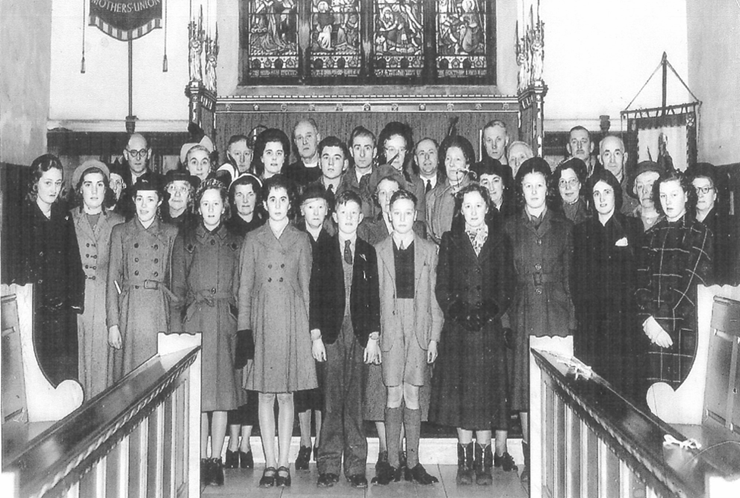
Back Row (Left to Right)
Ronnie Martin, Nat Steels, William Metcalfe (Billy Chinks), Dorothy Kassel, JL G Hill (vicar), John Cocket, William Metcalfe, Laura Outhwaite, Bob Spencer, Hilda Heselden, Chris Chapman, Tom Brooksbank, Jack (John Henry) Steels, Tom Outhwaite
Middle Row
Miss Allen, Annie Metcalfe, Jenny Martin, Annie Mason, Hannah Taylor, Miss Annie Chapman, Miss Allen, Miss Kassel (sen)
Front Row
Gladys Ramsden (nee Metcalfe), Irene Whitehead (nee Calvert), Shirley Iveson (nee batty), Margaret Heselden (nee Calvert), Jennifer Steels, John Batty, John Moore, Mable Metcalfe, Elizabeth Mason, Mabel Metcalfe (Penn Lane), Margaret Mason
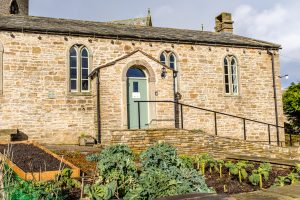
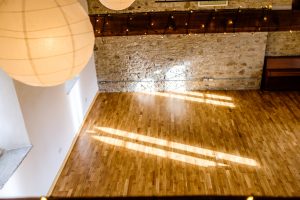
The NASH is the building behind St Margaret’s Church. You approach it as you walk on the Pennine Way at the north end of Bealah Bank. It was built in 1845 as ‘The National School Hawes’ and was a church school for just over 30 years, after which it was used as a hall by local groups including the Sunday School, Guides, Brownies and Mother’s Union for most of the twentieth century. Gradually it fell into a state of disrepair and was bought by its current owners in 2014. After renovations it has now become a home and a studio space which is used for weekly dance lessons, arts and heritage projects and by the local Sunday School. For more details visit the website https://www.thenashhawes.org/.
The development of local education and the National School
Early education in Hawes and the Upper Dale was through a series of private enterprises and schools. These ranged from a school held possibly in the Old Hall at Gayle by Matthew Wetherald in the early 18th century, to a ‘Dame’ school held in the White Hart room by Sarah Hogg in 1823 and a school in the Quaker Meeting House by Mary Jane Clarke in 1867.
The Hawes Grammar School was established in 1729 with Rev Peter Dawes of Hawes being the prime mover in its development. It was built on the ‘Early Haw’ and the building is now used as a ‘Florist’. It originally provided for 45 students, five of those being ‘free places’ – the exact nature of these being disputed. The school closed in 1899, twenty years after the present Hawes ‘Board’ school was built and opened in 1879 along with schools in Widdale and Lunds. School fees continued to be charged in these schools until 1891.
Until this time, most schooling was beyond the reach of the local population and few children had any formal education. The establishment of National Schools in many parishes during the 19th century was a response to the growing demand for the education of young people.
The National School in Hawes was built on land called the ‘Maiden Haw Brae’ in 1845 and opened the following year. Money was raised by public subscription and the original committee included Rev E Howell (the then curate). As recorded by John Iveson, the headmaster between 1871 and 1876, there were 100 pupils and two teachers – the junior teacher being untrained and unable to enforce discipline. Because attendance was not compulsory by law, absenteeism was common, especially during bad weather, around hay time and during fairs. There were also several outbreaks of contagious diseases which seriously affected attendance. Children would often stay away to watch things like local foxhunts or the building of the local railway.
However, at a time when education opportunities were limited, the National School met a real parish need. Literacy levels were significantly increased during its existence.
Acknowledgements to and for more information: Under Wetherfell, James Alderson; Wensleydale Press 1980
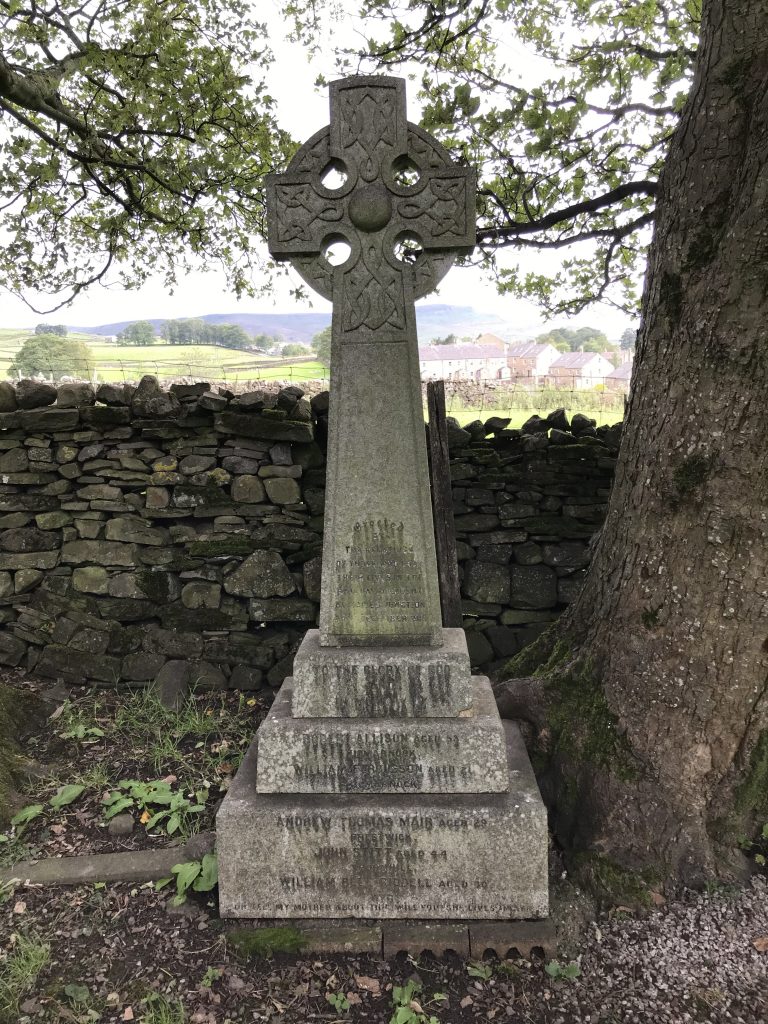 The story begins (or ends) with a memorial to people who died in a train crash, which is found in the upper graveyard in Hawes.
The disaster occurred on the Settle to Carlisle railway near Hawes Junction (now just Garsdale station) on Christmas Eve in 1910. Several homeward bound passengers to Scotland were killed and many injured. The last words of one young man (William Bell Riddell) as he lay dying are movingly recorded here on the bottom of the cross “0, tell my mother what happened to me, she lives in Ayr,”
The details of the accident are well documented on Wikipedia and other sources.
Since 1953 the Vicar of Hawes has also been Vicar of Hardraw, which was formerly an autonomous parish with its own incumbent and included the remote parish of Lunds whose small chapel has long been derelict.