In and around St Margarets
Our church is filled with stories, craftsmanship, and quiet beauty. Scattered throughout the building are objects, windows, and architectural details that each carry their own history and meaning. Here, you can wander at your own pace and discover the artistry behind our stained‑glass windows, learn the origins of cherished objects that have been part of our community for generations, find the small details you may have walked past a hundred times, now brought to life with context and care. This space is your guide to everything in and around our church — a place to explore, reflect, and appreciate the beauty that surrounds us.
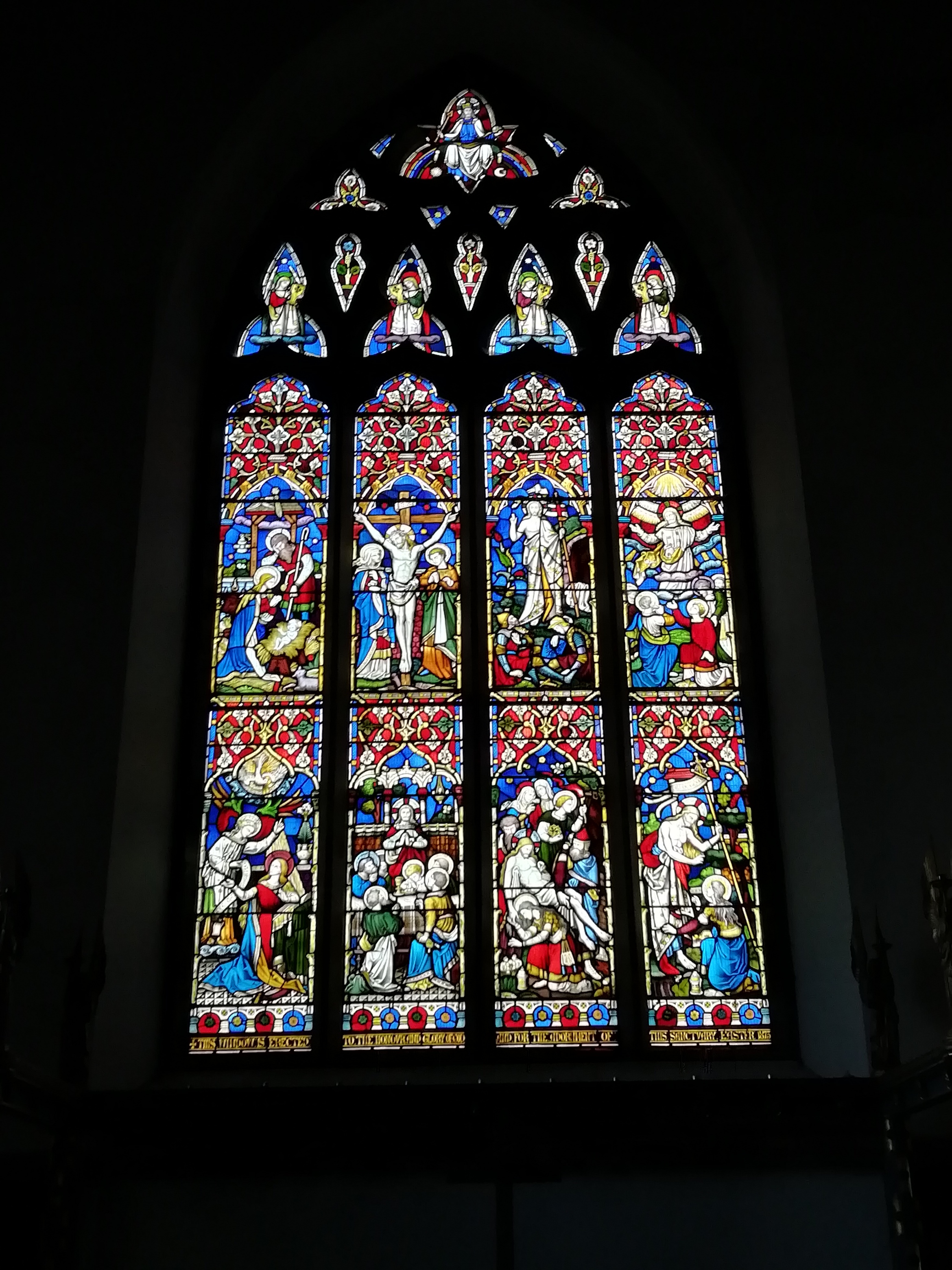
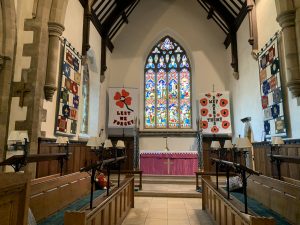
The East Window was designed by Mr G J Baguley of Newcastle upon Tyne along with the Lady Chapel Window. (Parish Magazine of May 1873)
The inscription across the bottom of the window indicates the date of the dedication
This window erected to the honour and glory of God and for the adornment of this sanctuary. Easter 1873
Trace the story of Jesus’ birth, death, resurrection and ascension through the main eight panels in the window. (start in the bottom left)
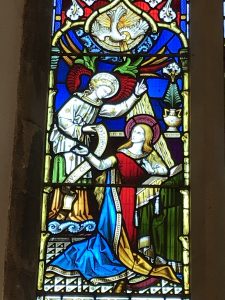 The Annunciation (bottom left). The account of this event is recorded in Luke’s Gospel, chapter 1. Mary is naturally fearful of the of the angel’s announcement but is reassured as Gabriel proclaims God’s favour and that he has chosen her to bear his son Jesus. The work of the Holy Spirit is represented in the window by the image of the Dove above the picture. Gabriel declared that Jesus
‘……… will be great and will be called Son of the Most High’
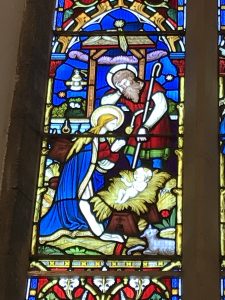 The Birth of Jesus (top left). Jesus’ birth (Luke chapter 2) is here depicted with Mary and Joseph looking on as Jesus lies in a manger – an animal trough. These humble beginnings help us understand some of the imagery in the account of the suffering servant of Isaiah 53 and the true nature of Jesus Christ who came to be our Saviour.
The lamb in the bottom of the picture reminds us that some of the first visitors and witnesses to this event were the shepherds. They had heard the announcement of the birth from the ‘Angel of the Lord’ as they were looking after the flocks in fields nearby. We remember also that Jesus is called the ‘Lamb of God’ and he was to become the true sacrificial lamb in his death on the cross where he paid the price for our sins.
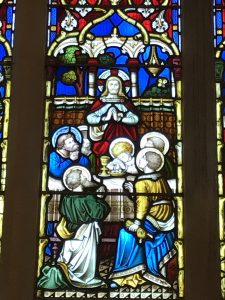
The last Supper (bottom middle left). Here Jesus is sharing the Passover meal with his disciples and he uses this time to describe the bread and wine as representing his broken body and blood to be spilt in his imminent crucifixion.
The cup of wine and the plate of bread are central in the picture with five of the disciples visible. Judas is one. He is shown holding a bag of money, for he had already agreed to betray Jesus to the chief priests. (Matthew 26 v 14ff)
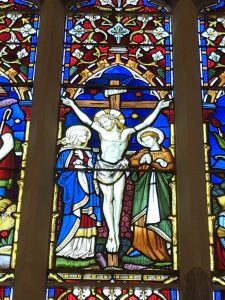 The Crucifixion (top middle left). Jesus’ crucifixion is described in all four Gospels. The window depicts the Crucifixion scene with two of his disciples looking on. Jesus is seen fastened to a wooden cross with nails through his hands and feet and wearing a crown of thorns on his head. When Jesus was being questioned before Pilate, he was flogged and the soldiers mocked him by making the crown of thorns and striking him in the face. (John 19) Pilate had a controversial sign made to put on the cross above Jesus’ head which read – ‘Jesus of Nazareth, the King of the Jews’
‘…. being found in appearance as a man, he humbled himself and became obedient to death – even death on the cross!’ Philippians 2 v 8
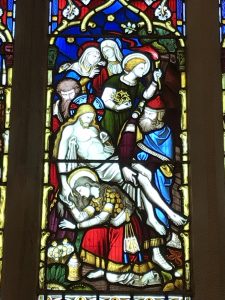
Jesus’ Burial (bottom middle right). This image depicts Jesus being taken from the cross late in the day of preparation before the sabbath. There are six characters shown helping in this event but the key actors would have been Joseph from Arimathea who provided the tomb for Jesus’ burial, and Nicodemus who had met Jesus late one night some time earlier. (John Chapter 3) He was a Pharisee but secretly a follower of Jesus. One of the disciples is shown carrying the crown of thorns that Jesus had been wearing and a lit torch as it was late in the day. At the bottom of the picture is a jar, possibly for spices that were put in the cloths that Jesus was to be wrapped in or it may be for the spices that the women were to prepare later that night at home, after they had followed and watched where Jesus was being buried.
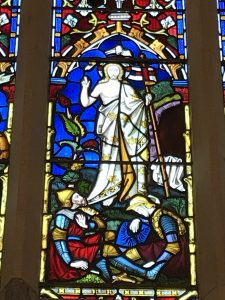 The Resurrection (top middle right). Jesus’ resurrection is seen in the image of the open tomb with the white grave clothes left as Jesus rose from the dead. The event was dramatic in every sense of the word. At the moment of the resurrection there was a violent earthquake and an Angel of the Lord came down from heaven to roll the stone away from the entrance of the tomb. The soldiers, shown here, who had been commissioned to guard the tomb were so frightened seeing this unfold that they froze as if they were dead. When the guards reported to the chief priests they were paid money to lie and spread a false account of these events. (Matthew 28)
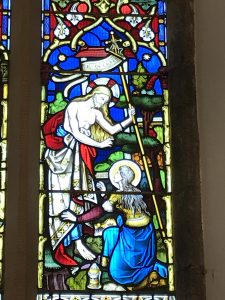
Jesus meets Mary in the garden (bottom right). Mary Magdalene had been one of the first to visit Jesus’ tomb early in the morning. Seeing the stone rolled away and the tomb empty, she ran to the other disciples believing that Jesus’ body had been taken away by someone. As the disciples dispersed after seeing the empty tomb, Mary stayed and saw the two angels who asked her why she was so distressed. Then Jesus appeared to her and when he spoke her name, she recognized him. Jesus said ‘I am returning to my father …. and my God…..’ and told her to tell the other disciples. Mary became the first witness and declared to them ‘I have seen the Lord’ (John Chapter 20)
In the picture of this encounter the nail marks in his hands and feet are visible as they were when Jesus later met with the disciples. The Jar of spices prepared by the women is at the bottom of the picture.
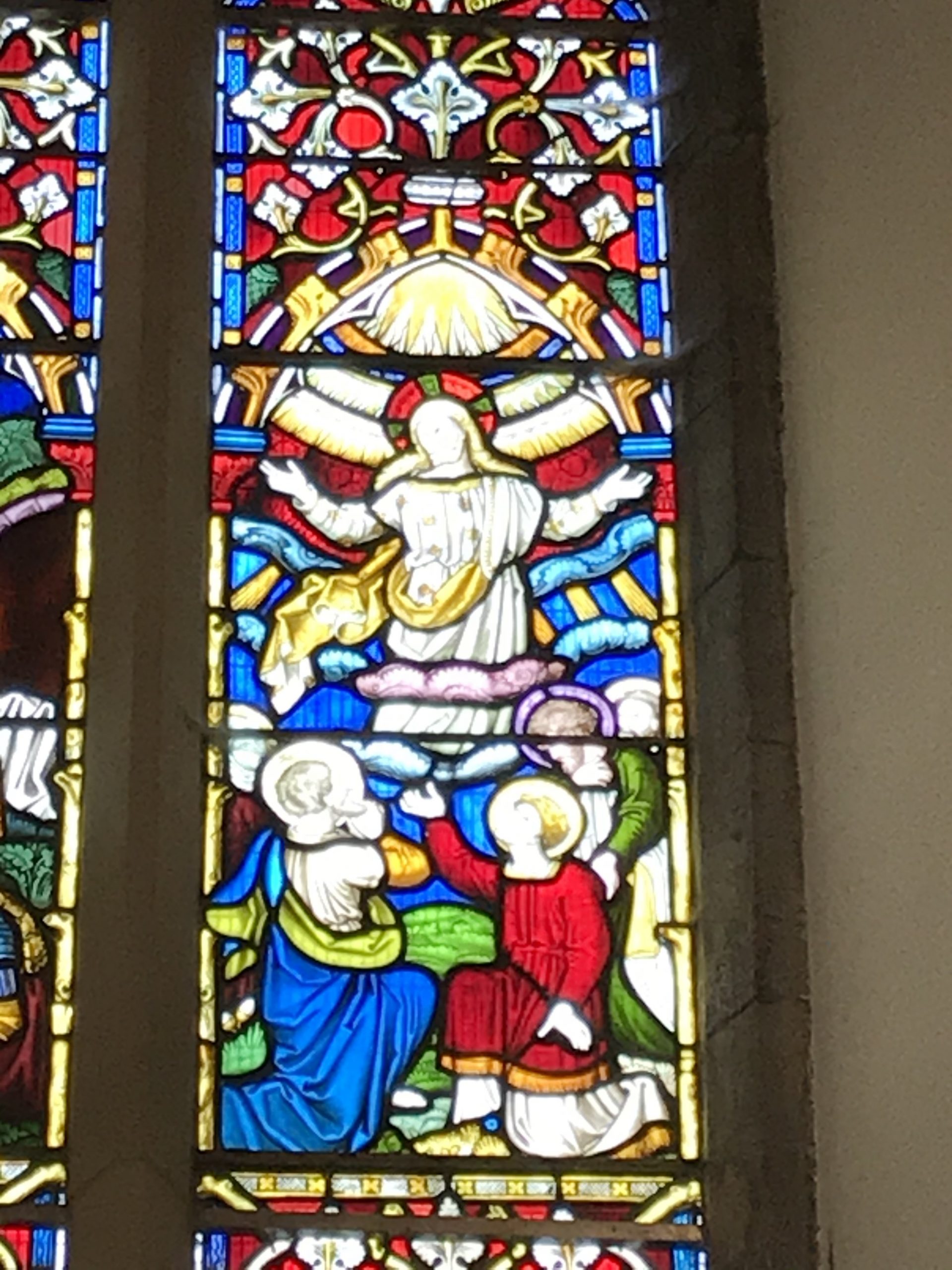
Ascension (top right). The account of Jesus’ ascension is found at the beginning of the Book of Acts. Jesus, meeting with the disciples told them that ‘…….they would receive power when the Holy Spirit came on them, and they would be witnesses in Jerusalem, and all Judea and Samaria, and to the ends of the earth’. Then as they watched, he was taken up into the clouds. As they stood amazed and looking into the sky, two men in white appeared next to them and declared that just as Jesus had ascended into heaven, he would return from heaven in the same way.
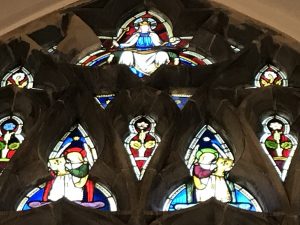
This event takes us to the top of the window where Jesus is depicted seated in Heaven, his sovereignty represented by the orb and mace that he holds. Below him are four lute playing angels. The account in the book of Revelation chapter 4 describes the Throne in Heaven and the One sat on the throne. The vision that John saw and recorded in his book was so amazing that he could only use some of the most precious stones he knew to describe the appearance of Jesus.
A rainbow surrounds the throne and Jesus in this top part of the window. This is the symbol of God’s covenant with his people.
And he who sat on there had the appearance of jasper and carnelian, and around the throne was a rainbow that had the appearance of an emerald. Revelation 4 v 3
Similar images of the Glory of God are described in Ezekiel chapter 1 where the Rainbow is used to describe the brightness of Jesus as he appeared sitting on the throne (v 28). The Rainbow is a constant reminder to the world of God’s grace and his promise of salvation.
The description in Revelation 4 continues by describing Jesus as holding a scroll in his hands which only he could open. There were four living creatures around the throne giving continual praise:
‘Holy, Holy, Holy is the Lord God Almighty, who was, who is, and is to come.’
The response of those elders watching on, was:
‘You are worthy, our Lord and God, to receive glory and honour and power,
for you created all things, and by your will they were created and have their being.’
and later:
To him who sits on the throne, and to the Lamb, be praise and honour and glory and power for ever and ever’
The image of Jesus sat on the throne is shown within in three cornered piece of glazing and below it are two similar shaped bits of glazing surrounded by stone. This pattern is seen in all the windows in the church. The image reminds us of the Trinity – God the Father, God the Son and God the Holy Spirit – the basis of our faith.
The events depicted in this window are spoken every week in our statement of faith – The Nicene Creed
Written by Mike Hirst
Celebrating the past and restored for the future
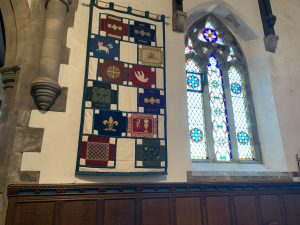 The two wall hangings either side of the chancel have been created by using covers from kneeler that were made between 1972 and 1989. The originals, which use a variety of tapestry stiches to form the designs had become very worn and in need of repair. They commemorate events both in the life of the church and the nation: the centenary of the Church of England’s Children’s Society and the Queen’s Silver Jubilee.
Other work depicts Christian symbols such as the Dove of Peace for the Holy Spirit, Jesus Christ as the Lamb, a Celtic Cross and the Bread and Wine used in Communion services to remember Jesus at the last supper. You will also see the initials of some of the Ladies of the church who stitched them.
They have all been skilfully repaired and restored by our Church Warden, Julia Di Duca during the first six months of the 2020 Pandemic.
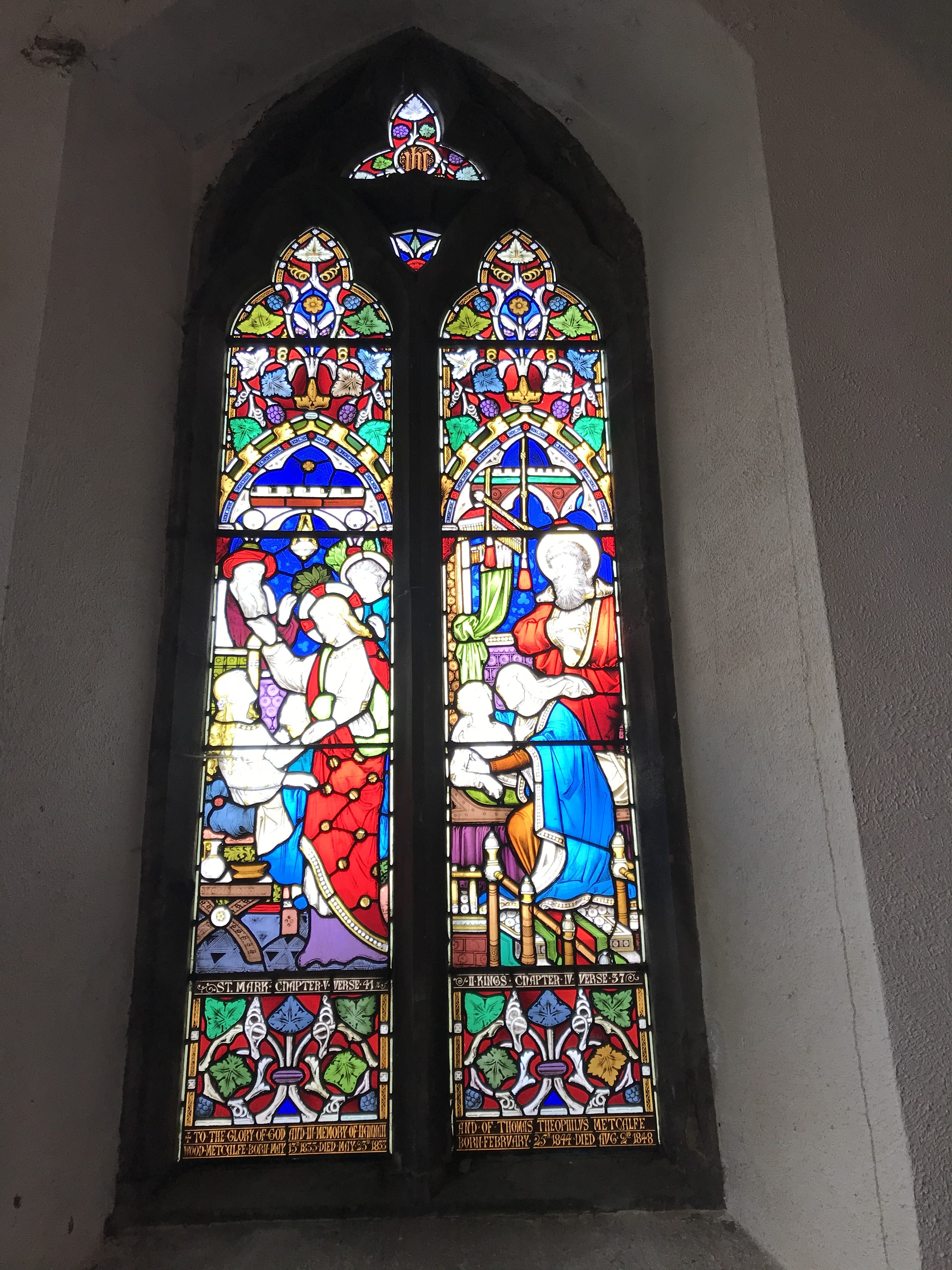
The Lady Chapel window, along with the East Window, was designed by Mr. G. J. Baguley of Newcastle on Tyne (Parish Magazine of May 1873).The window was given by the then
incumbent, the Rev’d J. Metcalfe, and his wife as a memorial to two of their children who died young. Hannah Wood Metcalfe 10 days and Thomas Theophilus Metcalfe 4 and half years
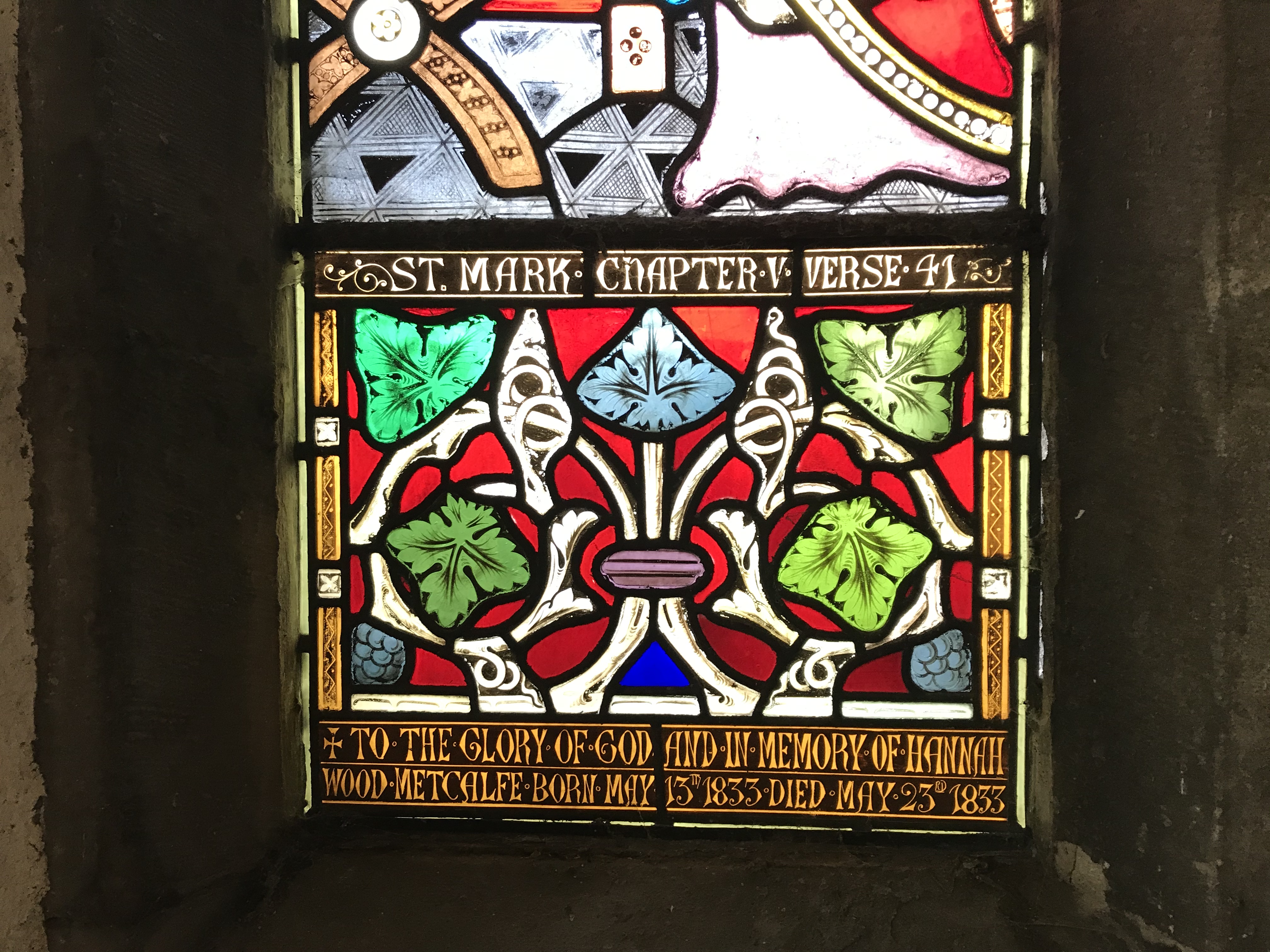 The window depicts two biblical events with resurrection themes, one from Mark chapter 5 – the account of Jesus raising the daughter of Jairus. Jairus was a ruler in the synagogue. On meeting Jesus he pleaded for him to come to his house and heal his daughter whom he believed was dying. Jesus’ visit to Jairus’ house was delayed by a woman in the crowd who also sought healing and before he reached the house, messengers arrived to say the girl had died. On approaching the house and seeing the commotion, he said the girl was ‘only sleeping’. The people mocked him, but taking the parents and the those disciples who accompanied him into the girl’s room, he brought her back to life. People were amazed and astonished.
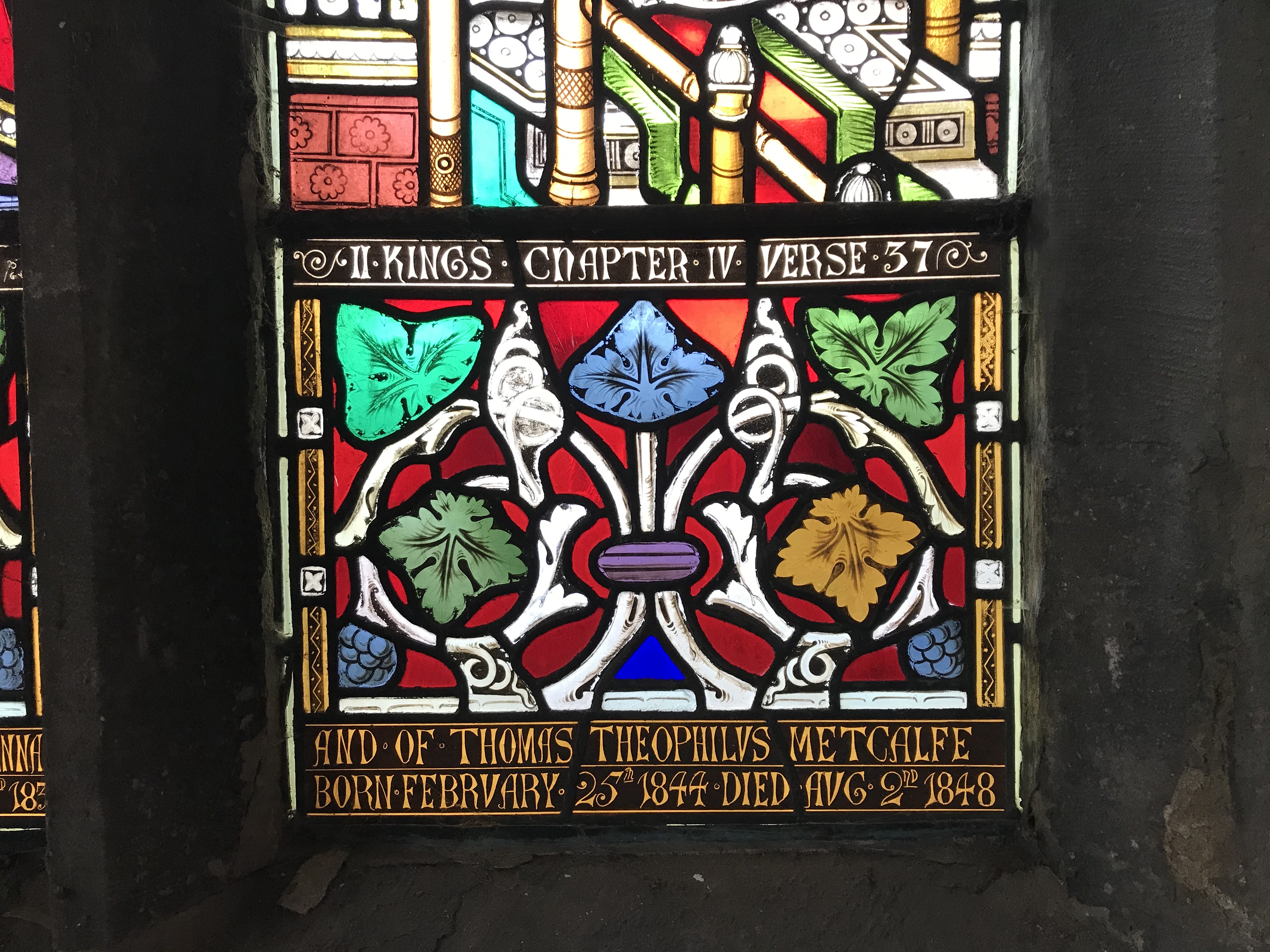 The second story is from 2 Kings chapter 4 where there is the account of Elisha raising the Shunammite child from death. Elisha regularly visited a family in Shunam in the territory of Issachar, and they had a room made available for him in their house. One day their son died after experiencing a severe headache and his mother laid him in Elisha’s room and set out to find Elisha at Mt Carmel, knowing he was a man of God. Elisha and and his servant Gehazi followed her home and Elisha prayed and breathed life back into the child. (read the detail and find out more about this family’s story in the second book of Kings)
Jesus said ‘I am the resurrection and the life. He who believes in me will live, even though he dies’. (John 11 v 25) He spoke these words to Martha before he raised her brother Lazarus from the grave. His words and actions are fully understood when we see the power that God has over death as he raised Jesus from the tomb and declared victory over death. (See these events depicted in the panels of the East Window.)
Resurrection life is available today to all those who believe in Jesus.
Written by Mike Hirst
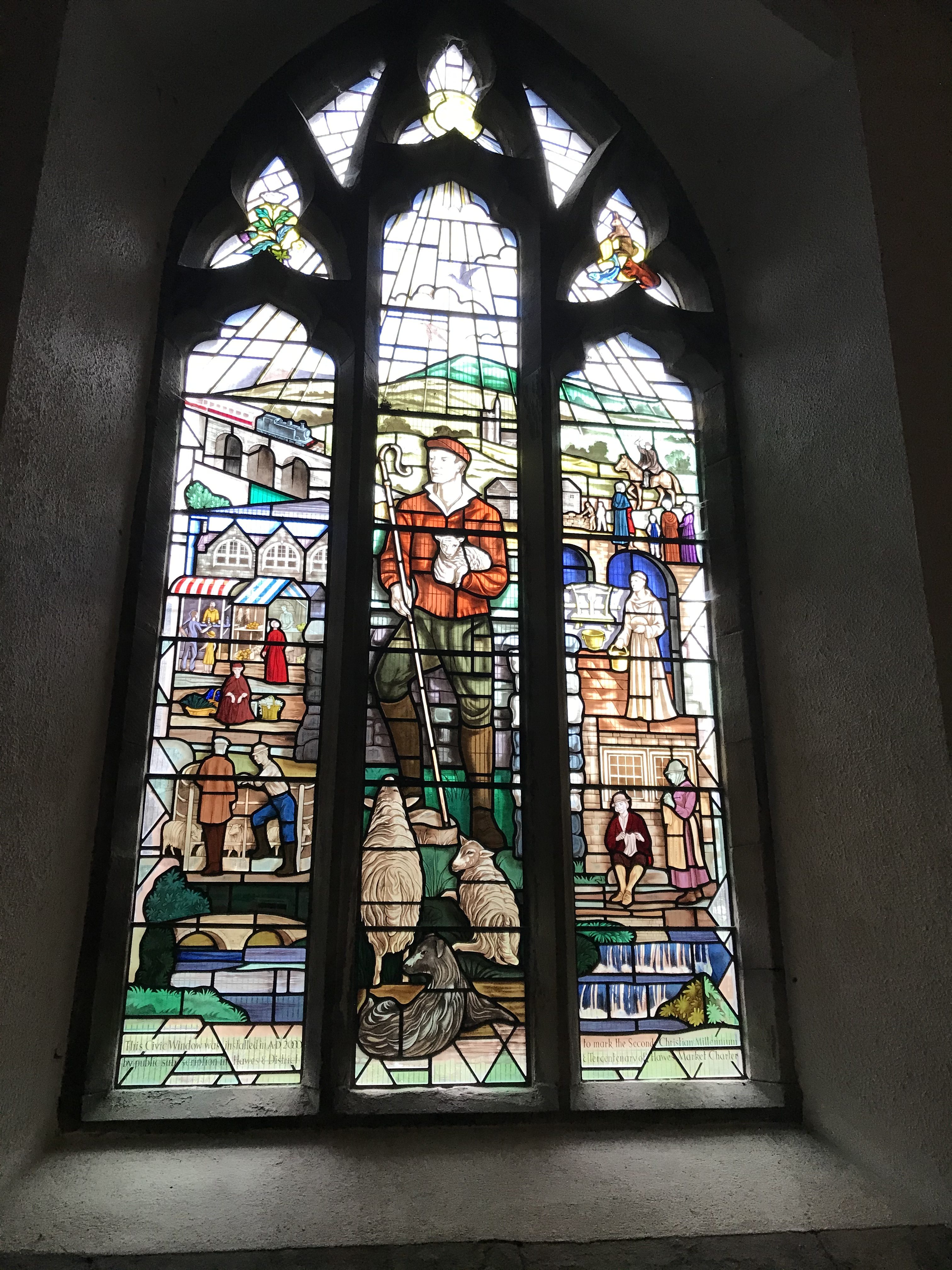
The millennium window is located in the south aisle of the church. The Parochial Church Council decided that to mark both the Christian 2nd Millennium of 2000AD and the Tricentenary of the granting of Hawes Market Charter it would like to replace one of the most severely damaged windows with an entirely new commemorative Civic Window depicting themes appropriate to the dale. A Millennium Window Committee was set up with representatives from the Parish Council, the Methodist churches and the business community. A distinguished stained glass designer, Mr Sep Waugh of York was invited for consultations. The cost was anticipated to exceed £12,000, and money was sought from the Market Tolls Trustees, who – ever since the Market Chatter was granted – have applied the rents for the open air Tuesday Market for the welfare of the town and its people. They responded very generously with a promise to pay for the entire central panel. The church itself also promised a substantial sum from its own resources and Mr. Waugh was then commissioned to make a design incorporating suggestions from local people.
The central motif was to represent the Good Shepherd and was in the guise of a modern Dales farmer which, from the outset, was seen as particularly apt since sheep-farming has been the staple of life and work here for a thousand years or so.
Jesus said ‘ I am the good shepherd. The good shepherd lays down his life for the sheep ….. I know my sheep and my sheep know me’ John chapter 10
Numerous suggestions for scenes from local history, landscapes and activities were discussed and Mr Waugh incorporated many in his final. In due course, a general appeal was distributed to every household and business in the parish – including the outlying villages – promising that the names of all who gave would be inscribed in a Donors’ Book. This is now displayed in a case near the pulpit. The response was immediate and heart-warming. Enough funds were raised not only to design, make and install the window but also to erect the best available exterior protection. It was dedicated by the Bishop of Ripon and Leeds in a Festival Civic Service on Advent Sunday 2000.
The inscription at the bottom of the window reads:
This civic window was installed in ad 2000 by public subscription in Hawes and
district to mark the second Christian millennium and tercentenary of Hawes market charter.
The left hand light shows Appersett viaduct with a train going over it. Below that is the Market House with market stalls in front and ladies with shopping. Below are two men at the auction mart; and finally Haylands bridge over the river Ure.
The centre light depicts Jesus, strikingly as a modern day good shepherd, carrying a lamb, with the church of St Margaret, Stags Fell and Cotter End in the background.
The right hand light shows John Wesley preaching on horseback; the monks of Jervaux Abbey who introduced cheese making into the dales; the legendary “Knitters of Gayle”; and a waterfall. There are many in the dales including the highest in England behind the Green Dragon Inn at Hardraw.
The smaller lights depict flora and fauna of the dales, meadow flowers, curlews, a rabbit, squirrel and trout and surmounting all, “the Sun”.
Acknowledgements to Dr Trevor Johnson and Hugh Bridgman
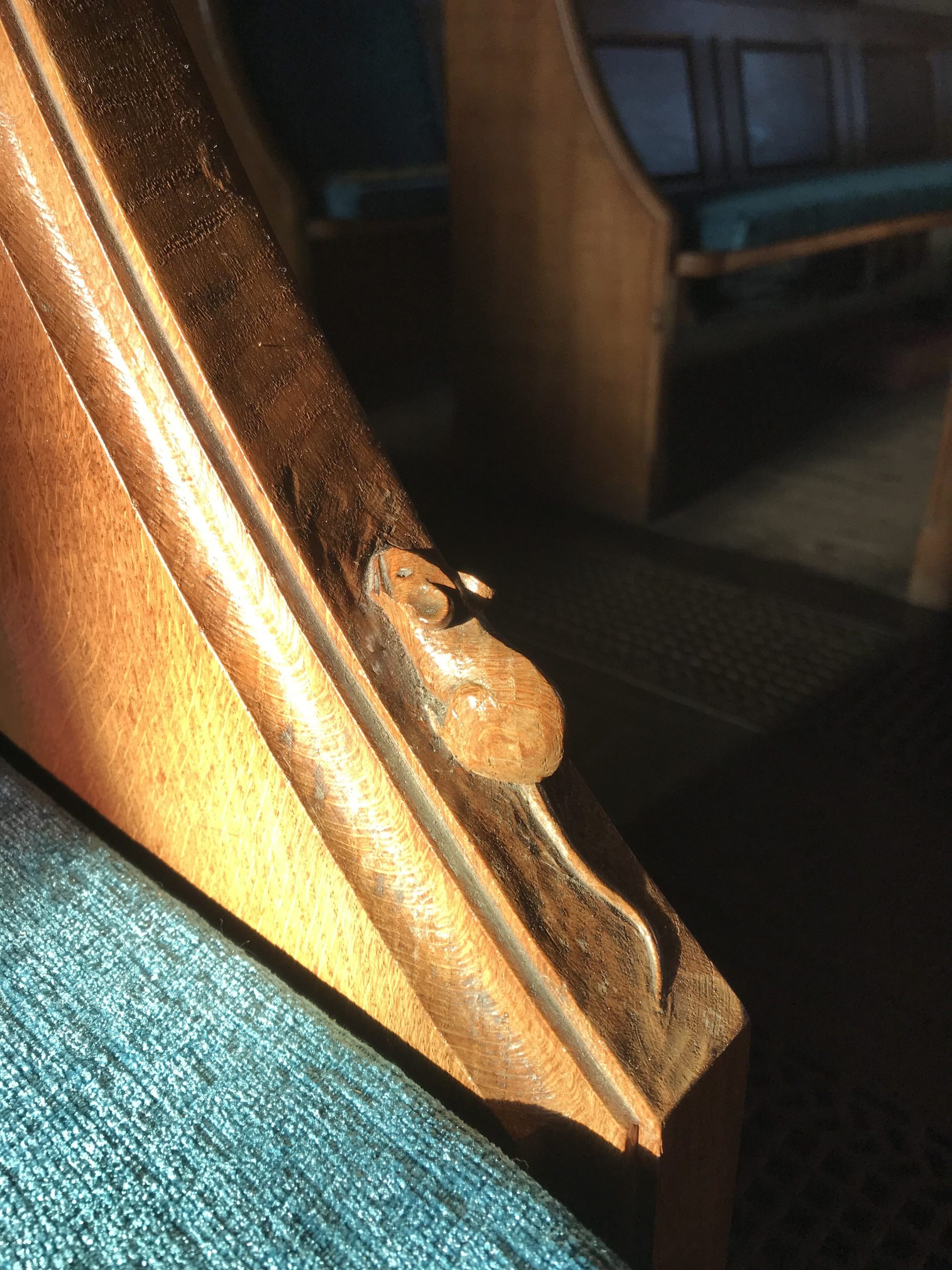
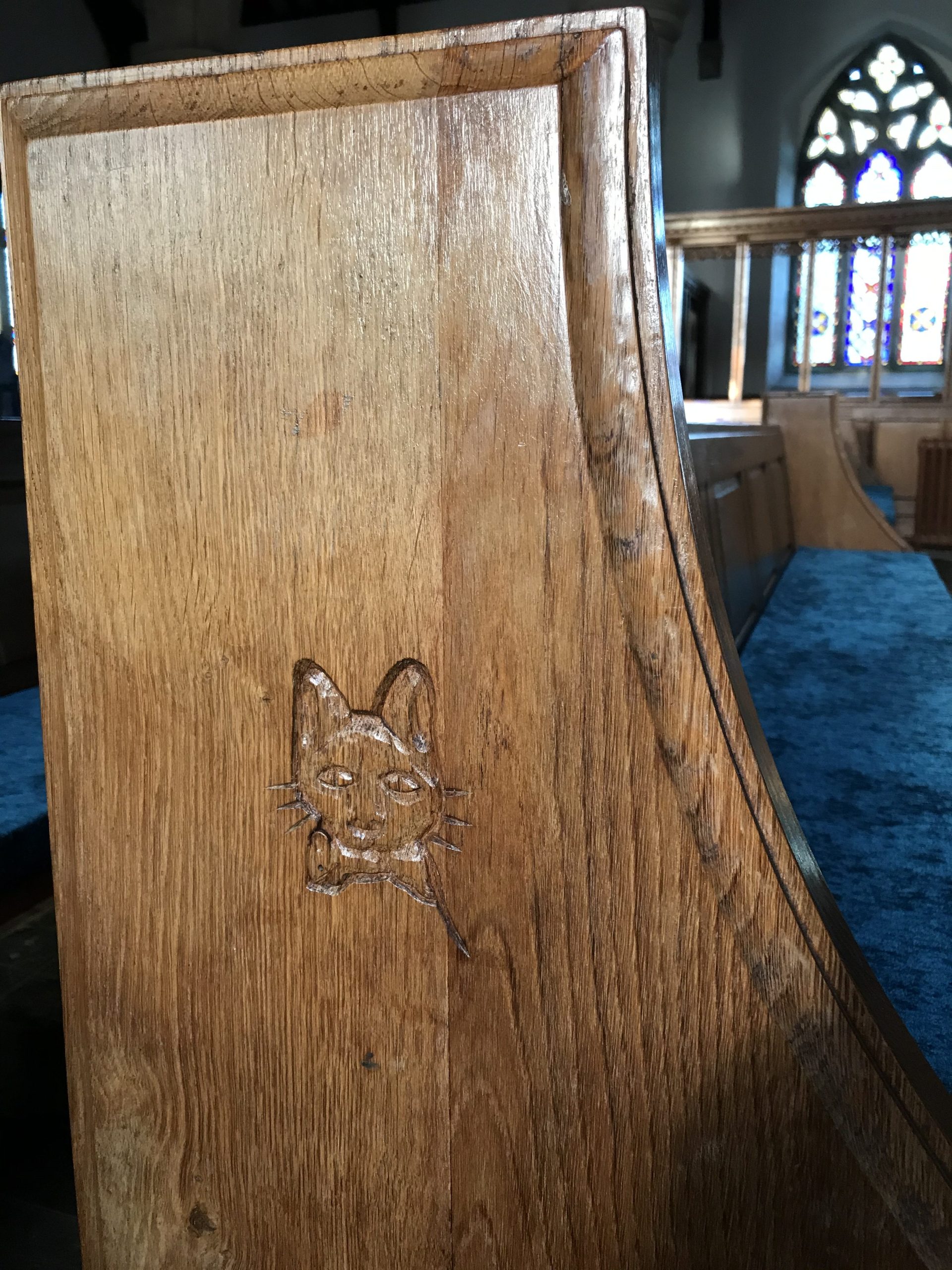
The main body of the church contains some of its finest features – the superb oak furniture which, during the long incumbency of Canon Grice-Hill gradually replaced the original Victorian pitch-pine pews. It is all in hand-carved English oak, oak-pinned (not screwed) together, and most of it is either by Thompson, the famous ‘Mouseman’ of Kilburn – so called because his trade-mark was the tiny mouse he carved into all his work – or by his one time apprentice Lyndon Hammel of Harmby (whose own mark is a cat that has caught a mouse). Robert Thompson was a late disciple of the Arts and Craft movement which advocated a return to traditional methods and materials, and even where the work is not by him or Hammel, it is in the same tradition. A careful scrutiny will reveal a wealth of delightful small carvings depicting the flora and fauna of the Dales, Christian symbols, and even the traditional Green Man (he isn’t immediately obvious). Since each panel has the name of its donors carved into it, few of whom were wealthy people, the whole forms an eloquent tribute to the many who worshipped here during the twentieth century. It is questionable whether any church has a finer collection of the Thompson school’s superb craftsmanship than can’ be seen here. Moreover, the pews are quite comfortable to sit in especially with the recently refurbished cushions – a rare boom!
Acknowledgements to Dr Trevor Johnson and Hugh Bridgman
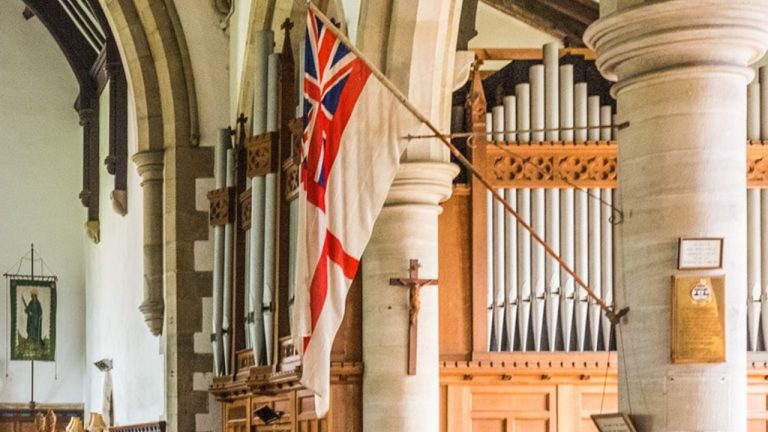
The ensign of the HMS Wensleydale has been in St Margaret’s church for over 30 years. It was lowered by Able Seaman John McLeod on 17th May 1945 and he kept it until 1992. The flag was hung in the south side of the nave until recently. It has been renovated and is now displayed in the north aisle in an oak cabinet made by Terry Harrington. The restoration was paid for from donations from the British Legion and collections at the remembrance services.
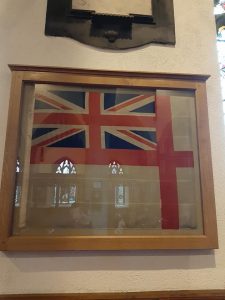
HMS Wensleydale Restored Flag
The Brass Plaque shown in the photograph (and now opposite the flag) reads:
In proud and affectionate memory of a fine ship, her valiant service and happy company unveiled in the presence of former shipmates on the fiftieth anniversary of commissioning 24th October 1992. Battle Honours: Normandy 1944; English Channel 1943 – 44; Atlantic 1943 – 44; North Sea 1943 – 44
HMS Wensleydale was a Type III Hunt Class Escort Destroyer. It was one of 86 built and they were named after English Foxhunts. It was fitted with 4, 4inch guns, 4 2pdr pom poms, 2,21inch torpedo tubes and carried around 110 depth chargers. It was designed as an anti submarine and anti aircraft escort for convoys.
Wensleydale was built on the Clyde by Yarrow’s of Scotstown, Glasgow and commissioned in September 1942. She sailed first in November for Tobermory on Mull to participate in training exercises and then to sea going trials in the Scarpa Flow.
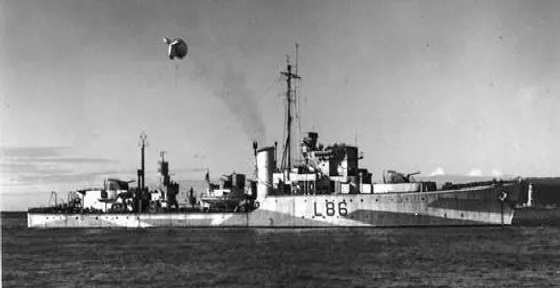
Early operations involved escorting convoys to Gibraltar, taking wide routes into the Atlantic to avoid U Boats (but not the 40ft Waves!). Long range escorting finished in early 1943 and following that Wensleydale was based around the channel ports -mainly operating in the channel and the North Sea, beginning by rescuing downed aircraft and airmen. Ongoing, she was involved with several training exercises, action against German E boats, patrolling Convoy routes, providing anti-submarine escort for battleships, assisting in mine sweeping and battles with German minesweepers. In September 1943 Wensleydale took the Commodore on board and was part of Operation Starkey – a rehearsal for D Day. Wensleydale was involved in exercises at Slapton Sands and Lyme Bay where E boats had sunk shipping with a large loss of American lives. She also provided cover for American landing on Omaha Beach 6 June 1944.
On the night 20/21st of November 1944, Wensleydale left Sheerness to take up an anti E-Boat patrol line on the Dutch coast. However, because of adverse weather it was decided that E-boat activity was unlikely. Therefore, Wensleydale was ordered to anchor for the night, off Southend. During the night, the ship was rammed on the port side. Water flooded the engine and gearing rooms. The port side and upper deck plating from frame 88 to 98 was indented, buckled and fractured to a depth of six feet on the upper deck for nearly half her length. This damage was caused by the Royal Navy operated LST 367 (Landing Ship Tank)
As a result of the collision the ship was reduced to category “C” reserve on 17 December 1944; and declared a Constructive Total Loss. However, on 28th February 1945, she was upgraded to category “B” reserve which suggested that the intention was to repair her. Nine months later, on 8th of November 1945 she was approved to scrap.
On 6th March 1946 she was again reduced to category “C” reserve at West Hartlepool and three months later, on 29th June 1946 she was placed on the sale list to a scrap yard. On 25th February 1947 Wensleydale arrived under tow at her final resting place; the yard of Hughes Bolckow, in Blyth; where she was broken up for scrap.
Torpedoman Reg Young writes:
Wensleydale was a beautiful ship, it could travel too. Everything about her was of the latest design, as was proved a few times when we had to find an aircrew that had come down in the Channel…… All this time I was on the Wensleydale from the time I saw her in Scotstoun being built to the time I had to leave her, I was happy – A good fighting ship, everyone gave as good as they could to do what we had to do.
For fuller accounts of specific engagements, details of some of the officers and crew and their memories see the web site compiled by David Allen https://www.hmswensleydale.co.uk/
Permission to use the above details – David Allen
Compiled by Mike Hirst
 Churches have not always had pews. In the 13th century stone seating began to appear initially around the sides of the church. In the 14th and 15th centuries wooden benches replaced many of the stone seats but for the most, people stood during the service. It wasn’t until the reformation when sermons became central to worship that people were encouraged to sit down and pews started to become the norm. In 1620 Archbishop Willian Laud required all churches to have pews though many major cathedrals didn’t see pews until 19th century and some still don’t.
In the past many parish churches had patrons who were significant in the ownership and upkeep of the church. They were often influential families who also created in the church ‘family pews’ or even whole ‘family boxes’. Other people could buy pews that were kept for their use only and they would have title deeds to the pews. Sometimes pews were originally installed at the expense of the congregation who then ‘owned’ their pew. It was also commonplace until early / mid 20thC to rent pews to families or individuals as a principal means of raising income. As a result the prevailing social hierarchies extended into the church.
When St Margaret’s church was built in the mid 19th Century, wooden pews would have been in place. What’s left of these Victorian pews can be seen against the back wall by the north porch and inside the porch. New pews were purchased and installed in the second half of the 20th Century. These were made by the ‘Mouseman’ firm of Robert Thompson and by Lyndon Hammel of Harmby. Contributions towards the cost of these came from local families and most of the pews have family names and family members who are commemorated.
It is believed that originally some pews in Hawes church would have been reserved by some families and individuals and the money paid would have augmented the parson’s stipend. Evidence for this is seen in in the brass pew plates which have been preserved and fastened to the one remaining Victorian pew at the rear of the nave. The dates of 1851 -52 suggest that his tradition continued into the new building. The names of the Rev’ds Lodge and Whaley were previous incumbents, whilst one plaque relates to a Londoner who ‘oddly’ was renting a pew in Hawes.
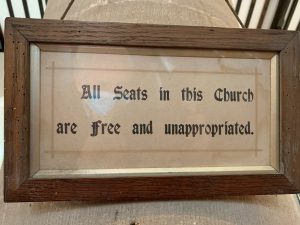
It is unsure when this arrangement of renting pews ceased and when this sign that all seats are free and unappropriated was originally posted in the church. It does now make a significant theological statement. The gospel – the good news of Jesus Christ is free to all those who would receive it.
For by grace you have been saved through faith. And this is not your own doing; it is the gift of God, Ephesians 2:8
Mike Hirst
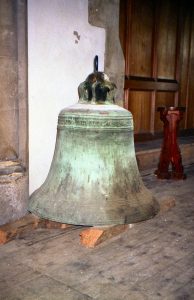
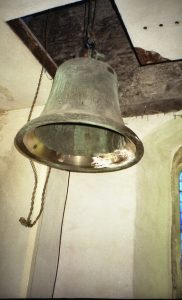
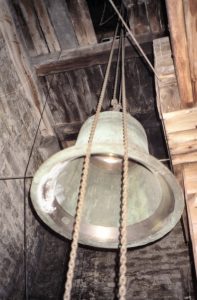
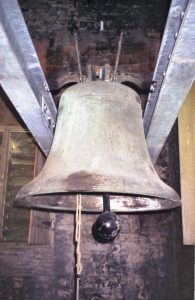
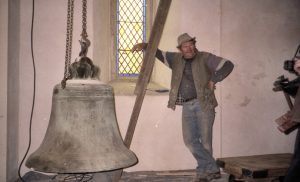
The church used to have a carillon – eight tubular chimes. The holes for the ropes for this can still be seen in the tower vestry ceiling. These did not produce much sound and became dangerous to use. In 1996 a new bell was sourced. This ‘new’ Bell was cast by John Martin of Worcester in 1650 for St Giles Church Sheldon where it remained until 1992. It was re hung in St Margaret’s tower in 1996.
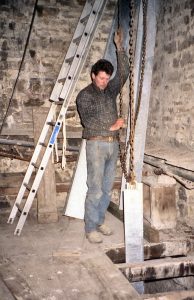
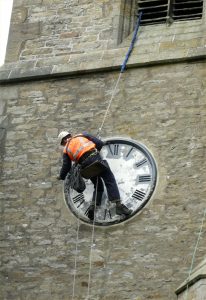
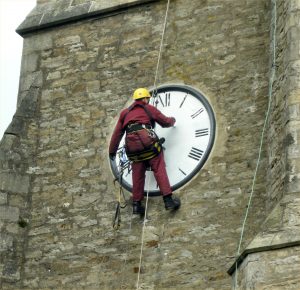
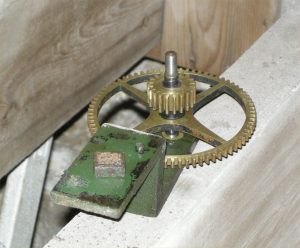
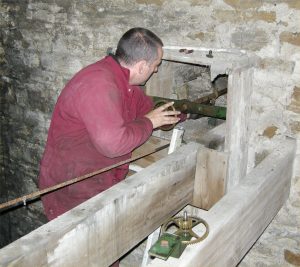
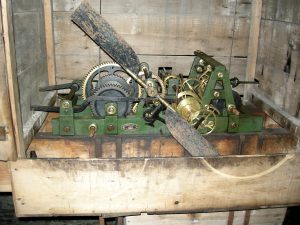
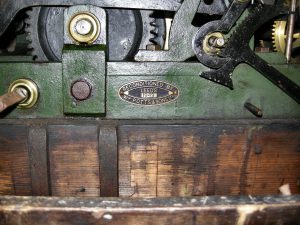
The clock is believed to be original to the church but was reconditioned in 1949. It was made by Gillet of Radciffe Terrace, London and is one of their earlier ones. When working it would strike on the hour. There were two weights – one for the strike and one for the clock. It is the hang of these that has been blocked by recent tower renovations and the reason why the clock is not working at present. Investigation are being made into developing an electrical winding mechanism.
The small bell – the clock bell, came from the original chapel of ease that was at the roadside and the bottom of the grave yard.
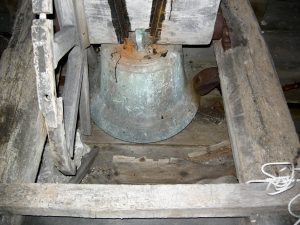
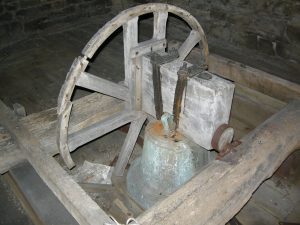
Click to enlarge
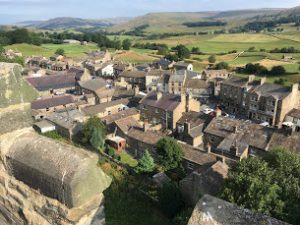
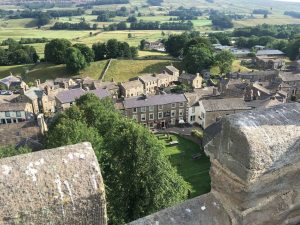
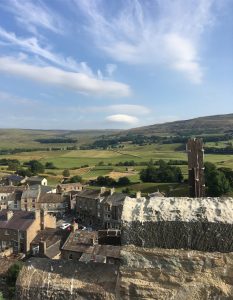
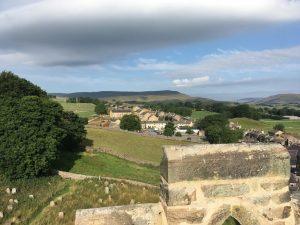
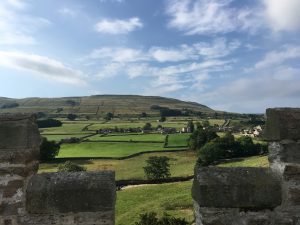
Photographs and details of most of the gravestones in St Margaret’s Graveyards can be seen on the following website: http://www.dalesgenealogy.com/Hawes/
Signs to the location of War Graves direct you to the top graveyard. Details can be found on the War Graves website.